
I told a friend I was planning on writing a post on fish cakes. Her response? “Ew. Fish cakes? Ew. That just sounds so wrong.”
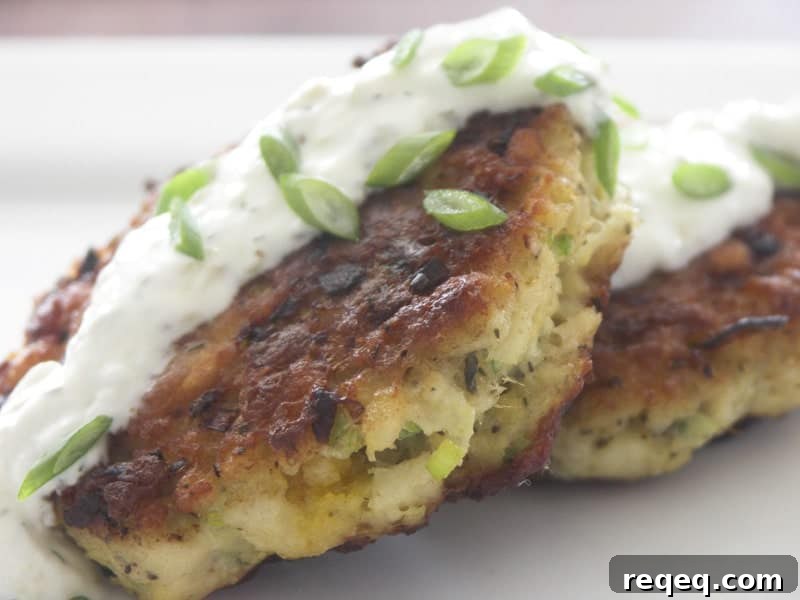
Admittedly, you don’t often hear the words “fish” and “cake” together. But think crab cakes—delicious. These New England Style Fish Cakes are crispy, browned patties studded with onion, celery and herbs and finished with creamy tartar sauce.
“I don’t know. The dish sounds good,” she said, “but that name needs some serious help.”
“How about New England Fish Cakes?” I asked.
“Oh yeah!” she said. “That sounds wonderful!”
Problem solved. Everything fish-related sounds a little better with “New England” attached. It conjures images of fishermen in heavy sweaters and yellow boots hauling their day’s catch on the wharf.
~~~ ~~~ ~~~
Despite my friend’s initial reaction, I’m completely in love with these New England Style Fish Cakes. They develop that satisfying, crunchy brown crust from time in a hot skillet with sizzling oil. The interior, speckled with scallion, parsley, celery and seasonings, is exactly what good fish should be—flavorful, moist and light in texture.
Fish can be a hard sell for some people, but these cakes convert skeptics. I once served one to a confirmed fish-hater. After a bit of coaxing she tried a bite, finished her plate, asked for seconds, then went home and made them for her family. She still insists she hates fish—but she makes these often.
*Fish is a good source of lean protein and omega-3 fatty acids, which support heart health.
For a printer-friendly, photo-free version of this recipe, see the original recipe source.
New England Style Fish Cakes
Ingredients:
- 2 pounds firm, boneless, skinless white fish fillets (cod, haddock, blue hake, or similar)
- 2 cups freshly made medium-fine breadcrumbs (about 6 slices of bread)
- 3 medium celery stalks, finely diced
- 1 bunch scallions, thinly sliced and minced
- 1/4 cup fresh parsley, chopped
- 3 large eggs
- 1 tablespoon dried basil
- 1 1/2 teaspoons Old Bay or seafood seasoning
- Salt and pepper, to taste
- Neutral oil (canola or similar) for pan-frying
Place the fish fillets on a clean cutting board and cut into roughly two-inch pieces. Transfer the fish to the bowl of a food processor fitted with a blade. Pulse several times until the fish is broken down into a coarse puree with no pieces larger than pebble-size. Some small texture is desirable.
Combine the processed fish with the breadcrumbs, diced celery, scallions, parsley, eggs, basil, seafood seasoning, salt and pepper in a large bowl. Stir until evenly combined.
Heat a 12-inch nonstick skillet over medium-high heat and add about a tablespoon of oil, swirling to coat the pan. Form the patties just before cooking to prevent them from falling apart; about 1/2 cup of mixture shaped into a thin patty works well. Handle gently so the interior stays light.
Carefully place patties into the hot oil. A 12-inch pan will usually hold four at a time. Increase the heat to high and cook the first side for about five minutes, until beautifully browned. Use a wide spatula (and a rubber spatula if needed) to flip each patty cautiously to avoid oil splatter. Cook the second side for another five minutes. Transfer finished cakes to a paper-towel-lined plate to drain and repeat with the remaining mixture, adding oil as needed.
Serve immediately, plain or with tartar sauce. These fish cakes have plenty of flavor on their own, but a good tartar sauce complements them perfectly.
Make a flavorful tartar sauce to match—this version is tangy, textured and versatile. It’s great on fish, burgers, fries or as a dip.
Tart-er Tartar Sauce
Ingredients:
- 1 cup Greek yogurt
- 1/4 cup mayonnaise
- 1/4 cup minced scallions
- 2 tablespoons minced cabbage
- 1 tablespoon minced green pepper
- 1 tablespoon lemon juice
- 2 teaspoons dill pickle relish
- 1/2 teaspoon dried dill
- 1/4 teaspoon celery seed
Combine all ingredients in a bowl, mix well, cover tightly and refrigerate for at least one hour to allow flavors to meld. Taste and adjust seasoning before serving.