
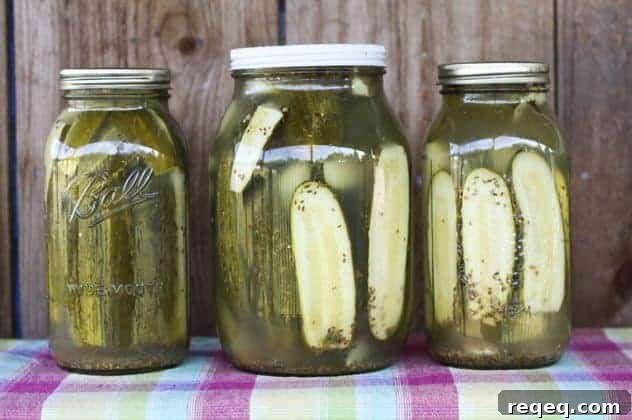
Yesterday marked the first truly joyful day of canning season for me: my garden surprised me with a colander full of pickling cucumbers.
Some of them had been stealthily growing into giant specimens, so my mission was simple.
Pickle them while they’re fresh. I sliced the larger cucumbers thin to make hamburger-style dill slices so they would fit into jars. The effort paid off: I ended up with two quarts and four pints of homemade Garlic Dill Pickles.
Many people feel intimidated by canning, and I get it. The constant warnings about food safety—botulism, salmonella, mold—can sound scary. Still, canning is an economical, reliable way to preserve excellent food at home when done correctly.
Pickling is one of the simplest canning tasks after jam, and it’s very forgiving. Below is a concise primer to help you make garlic dill pickles with confidence.
Dill Pickle Recipe Primer
Follow three basic rules to ensure success:
- Keep everything clean.
- Use the freshest produce available.
- Keep your hands and workspace impeccably clean.
Start with intact glass canning jars and new two-piece lids. Decorative hinge-style jars are nice for short-term storage, but two-piece lids seal more consistently for long-term shelf stability.
How many jars you need depends on your harvest. One peck of pickling cucumbers yields about 12 quarts of pickles. I’ll present the recipe as “per quart” so you can scale it up easily.
Use pickling cucumbers for the best, crunchiest results. Salad or slicing cucumbers can be pickled, but they usually become softer during processing. Pickling cucumbers typically have smaller, less noticeable seeds and a thinner skin that yields easily to a knife or a bite when fresh.
Store finished jars in a single layer on a cool, dry shelf—an enclosed cupboard or basement shelf works well. Homemade pickles are at their best when served very cold.
One counterintuitive but useful tip: remove the screw bands (rings) from the jars before you put them on the shelf. The rings only hold the lid in place during processing; leaving them on can hide problems. Remove them so you can check seals and catch any jars that have failed.
In ten years of canning I’ve had only one failure: a jar of blueberry jam that blew its lid. Because I had removed the ring and inspected the jars, I noticed the blown lid and the mold and safely discarded it. Trust advice from experienced canners—removing rings really helps you monitor your stored jars.
Pickles are generally safe thanks to the high acid and salt levels in the recipe, but contamination can happen. If you ever see any of the following signs, discard the jar immediately—don’t taste it to test it:
Signs your canned goods have gone bad:
- The lid is bulging or pops when pressed in the center.
- The lid has come off the jar entirely.
- The lid makes no vacuum “pop” when removed or gives no resistance.
- There is fuzzy or hairy growth on the surface.
- The contents smell foul or “off.”
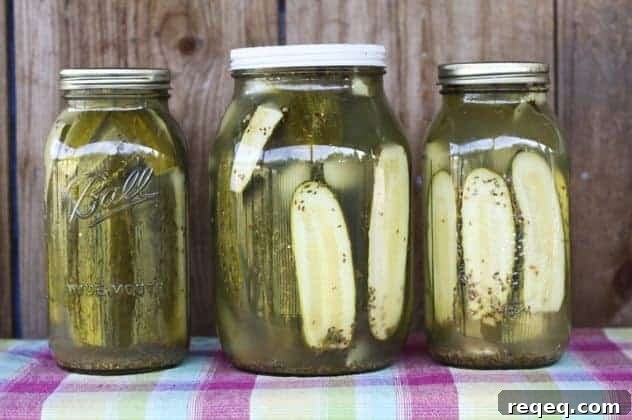
Garlic Dill Pickles
Rebecca Lindamood
Ingredients
For each quart of pickles you will need:
For the spices:
- 3-4 heads fresh dill or 1 tablespoon dried whole dill seed
- 2-3 large garlic cloves peeled
- 12 whole black peppercorns
- 1/2 small bay leaf
- 1/4 teaspoon whole mustard seed
- 1/2 teaspoon crushed red pepper flakes or 3 dried habaneros optional
For the brine:
- 1 cup cider or white wine vinegar Cider gives a classic pickle flavor; white wine yields a more delicate profile.
- 2 cups water
- 1 Tablespoon pickling salt Any non-iodized salt; kosher salt works well.
For the pickles:
- 2 pounds pickling cucumbers
Instructions
-
Clean and sterilize jars, lids, rings, a ladle or heatproof measuring cup, and a chopstick or butterknife for removing air bubbles. You can run items through a dishwasher on a hot cycle or immerse jars and utensils in boiling water for five minutes. To sterilize lids, pour boiling water over them in a bowl. Many home canners find a dishwasher makes this step easy.
-
Scrub cucumbers and slice a thin piece (about 1/16″) off the blossom end. This small cut reduces the chance of soft pickles, because the blossom end can contain enzymes that soften the flesh.
-
Trim cucumbers as needed to fit them into jars.
-
Estimate how many jars you’ll fill, line them up, and add the spices and garlic listed above into each jar. Pack cucumbers in snugly without crushing them, leaving 1/2″ headspace from the top rim to allow for proper sealing.
-
Scale the brine for the number of quarts you are making (for example, for 4 quarts use 4 cups vinegar, 8 cups water, 4 tablespoons pickling salt). Bring the brine to a boil, then ladle it into the jars while still boiling, keeping the 1/2″ headspace.
-
If the brine settles and more is needed, add a little more. Run a sterile chopstick or butterknife along the inside edge of each jar to release air bubbles, and top off with brine if necessary to maintain 1/2″ headspace.
-
Leftover brine can be saved in the refrigerator for another batch or used in cooking; it’s handy to make extra so you don’t run out mid-process.
-
Wipe jar rims with a clean towel, place lids on jars, and screw on rings until they provide resistance—don’t overtighten. The ring only holds the lid in place during processing; the vacuum seal forms as the jars cool.
-
Prepare a large pot with a tight-fitting lid deep enough to cover jars by one inch of boiling water. Test depth with the filled jars, then remove them, bring the water to a full boil, and carefully place jars back in the pot using a jar lifter or similar tool.
-
Cover and return the water to a rolling boil, then process quart jars for 20 minutes and pint jars for 15 minutes. Proper processing time is essential: it ensures safety and helps preserve texture and flavor.
-
When time is up, carefully remove jars to a cooling rack or towel. You’ll hear occasional “pops” as jars seal—this is good. Let jars cool overnight. The next morning, remove rings, wipe jars, and check lids: a sealed lid should not flex when pressed in the center. Any unsealed jars should be refrigerated and used first. Label jars with contents and date; flavors develop over time and these pickles are best after about six weeks.
Nutrition
Carbohydrates: 1g
Sodium: 440mg
Potassium: 90mg
Vitamin A: 60IU
Vitamin C: 1.9mg
Calcium: 13mg
Iron: 0.2mg
Nutritional information is an estimate provided as a courtesy. Calculate nutrition using the actual ingredients you use if you need precise values.
did you make this recipe?
Share photos on Instagram and tag the original author to show off your jars.