

This homemade Canadian bacon—cured pork loin with gentle maple and sage notes—surpasses any store-bought version I’ve ever tasted.
My household is unabashedly fond of meat, and pork in particular. Within that love affair, all forms of bacon make my family very happy.
After making traditional American bacon a few weeks ago, one of my kids strolled by munching a crispy strip and asked, “I wonder if Mom could make Canadian bacon, eh?”
They then clarified, with a grin, “That was a Canadian ‘eh’, not a Michigan one,” followed by laughter. It’s fun to watch the kids play with accents.

If I could make American bacon, why not try a North-of-the-border version? Canadian bacon is essentially lean, cured pork loin. Because it’s so lean, you usually only need to heat it through rather than frying it until crisp, making it a quick, convenient option for breakfast on the go.
Despite the name, traditional Canadian preparations vary—some Canadians make peameal bacon—but the style most of us think of is cured pork loin with a mild, slightly sweet flavor profile.
What surprised me most was how straightforward making this Canadian bacon is.
Even more surprising: the final product is remarkably delicious. This cured pork loin, subtly flavored with maple and sage, outshines any commercial Canadian bacon I’ve tried.
My informal taste-test panel (my husband and sons) agreed. In fact, this recipe has been requested as part of birthday meals multiple times.
What Is Canadian Bacon
True Canadian bacon starts with a center-cut boneless pork loin—not tenderloin. Many grocery stores sell center-cut loins in vacuum-sealed packages. The brine quantities in this recipe are suitable for about 4 pounds of pork loin; if you have a larger piece, increase the brine proportionally so the meat is fully covered.
To bring a distinctly maple note, I use Grade B dark maple syrup in the brine. If you can’t find Grade B, a good Grade A will work—the darker the syrup, the bolder the maple flavor. If maple isn’t available, a brown sugar pancake syrup can be used as a substitute, though the character will be slightly different.
Fresh sage adds an important herbaceous depth—grab a bunch from the store or a sprig from a garden if possible. Dried whole-leaf thyme works well here if fresh thyme isn’t available; thyme is less critical than fresh sage but still complementary.
Before brining, trim as much excess fat from the pork loin as practical. You don’t need to be overly precise; any remaining fat is easier to remove after cooking. Save trimmed fat to render later for use in cooking beans or other dishes.
I usually cut the loin into pieces that fit comfortably into gallon freezer bags so the meat stays submerged in brine.

Smoking the brined loin over applewood adds a fantastic flavor and is my preferred method, but if you don’t have a smoker you can roast the air-dried cured loin in a low oven until it reaches an internal temperature of 150°F. Instructions for both methods are included in the recipe below.
When cured with pink curing salt, the finished Canadian bacon will keep in the refrigerator for up to 10 days. It stores much longer when tightly wrapped and frozen.
Note on pink salt: I choose to use curing salt (Prague Powder #1) in this recipe because it extends shelf life and preserves a pink color in the meat. Omitting it will shorten refrigerated shelf life and produce a more brown-toned color. Curing salt reduces the risk of surface bacterial growth when used properly; this refers to curing powder, not Himalayan salt.
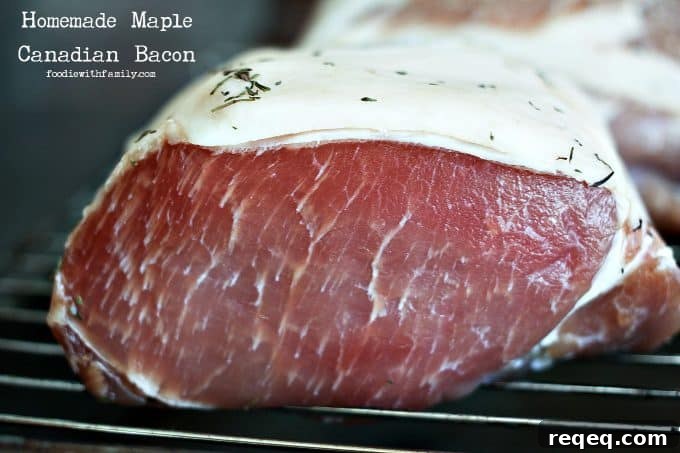

Homemade Maple Canadian Bacon {Smoker Optional}
Rebecca Lindamood
Ingredients
- 1 gallon water (4 liters)
- 1 1/2 cups Morton’s kosher salt (350 grams)
- 1 cup raw sugar (250 grams)
- 8 teaspoons pink curing salt (Prague Powder #1, 42 grams)
- 1 cup Grade B dark maple syrup (236 ml)
- 1 bunch fresh sage
- 1 tablespoon dried thyme
- 2 garlic cloves, peeled and lightly crushed
- 4 pounds boneless pork loin, excess fat removed
Instructions
- Combine water, kosher salt, raw sugar, pink salt, maple syrup, sage, thyme, and garlic in a stockpot. Bring to a simmer and stir until the salt and sugar dissolve. Remove from heat and refrigerate until thoroughly chilled.
- Trim the pork loin to fit into gallon freezer bags. Place the loins in the bags and pour the chilled brine over them, ensuring the meat is fully submerged. Squeeze out as much air as possible, place the bags in a high-sided roasting pan, and refrigerate for 72 hours.
- After 72 hours, drain the brine, rinse the loins, and set them on a rack over a baking sheet. Refrigerate uncovered for 24 hours to air dry.
To Smoke the Canadian Bacon:
- Hot smoke at 200°F over applewood chips for 2–3 hours, or until the internal temperature reaches 150°F, following your smoker’s instructions.
To Roast the Canadian Bacon:
- Preheat the oven to 200°F. Place the air-dried pork loin on its rack over a pan and roast until the internal temperature reaches 150°F.
- Trim any remaining fat, cool to room temperature, then wrap tightly. Refrigerate for up to 10 days, or double-wrap in plastic and foil and freeze for up to 6 months.
Nutrition
Carbohydrates: 13g
Protein: 12g
Fat: 2g
Sodium: 5921mg
Nutritional information is an estimate and provided as a courtesy. Calculate nutrition using the actual ingredients you use for accuracy.
If you tried this recipe, tag @foodiewithfam on Instagram and use #foodiewithfamily so I can see your results!