
Visit our Bread Recipes page for more wonderful homemade bread recipes!
Did Nicolas Sarkozy really ban cheese from the Élysée Palace? That sounds almost scandalous—especially in a country where cheese plays such an important role in the meal. French dining often includes a dedicated cheese course, and for many food lovers, skipping cheese is unthinkable. Brillat-Savarin, the great French gastronome, put it vividly: a dessert without cheese is like a beautiful woman missing an eye. In short, France runs on cheese.
Setting politics aside, the idea of removing cheese from palace menus is hard to accept. France produces an astonishing variety of cheeses, and forbidding them would rule out countless beloved dishes: tartiflette, quiche, fondue, tartine, soufflé, and gougères, to name a few. Today we focus on gougères—cheesy choux puffs that happen to be ideal for Make Ahead Mondays.
A friend suggested making gougères for a freezer-friendly batch: “Freezable comfort food? Yes, please.” It was an idea worth trying. Gougères are crisp on the outside, tender and airy inside, and full of cheesy flavor. They’re versatile—perfect as an appetizer, snack, breakfast with tea, or alongside soups and roasts. They’re also fun to say: gougère (GOO-zhair) has a delicious French sound to it compared with souffle (SOO-flay).
Gougères originate from pâte à choux, or choux pastry, the same dough used for éclairs, cream puffs, profiteroles, croquembouches, and Paris-Brests. Once you master choux, many classic desserts and savory treats are within reach. Plain choux puffs can be filled with sweet creams or savory salads, and the dough itself can be flavored in countless ways.
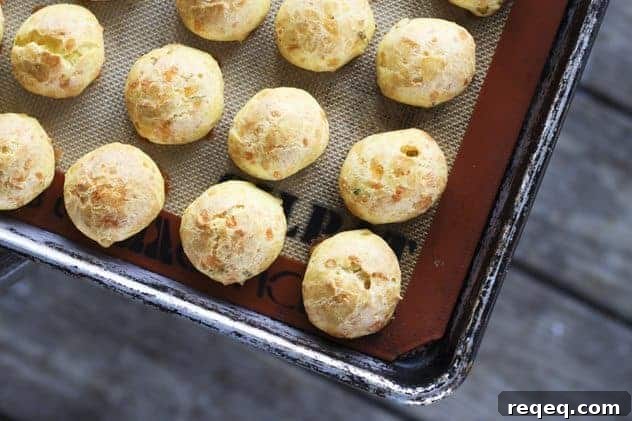
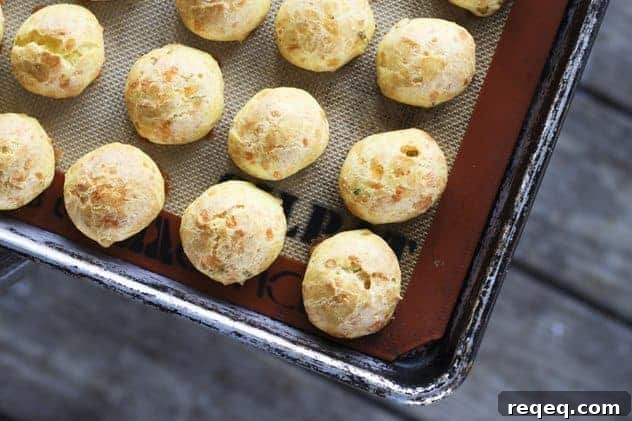
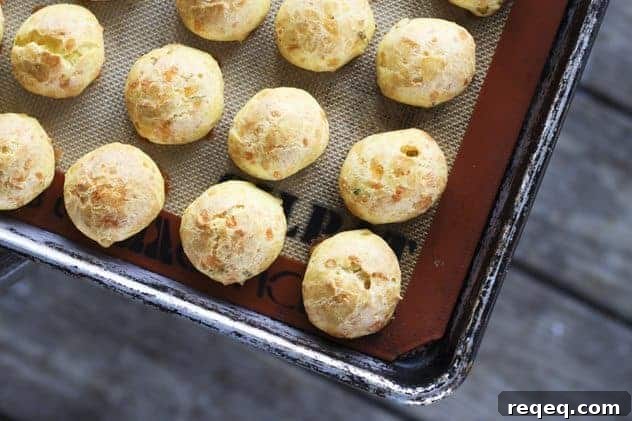
This recipe gives the traditional gougère a twist: instead of Swiss or Emmental, it uses a sharp American Cheddar for bold flavor. Dijon mustard replaces part of the water for a tangy note, and finely sliced scallions add a fresh, oniony bite. The dough must be portioned immediately after mixing, but you can freeze the piped or scooped mounds on a baking sheet and transfer them to freezer bags once firm. They keep for up to three months and can be baked straight from the freezer—cheesy, golden puffs ready in minutes.
What to serve with these? Gougères pair beautifully with brothy soups and stews, and they complement roasts, braises, and simple salads. They make excellent after-school snacks, a quick breakfast with tea, or an elegant bite for cocktail hour. A glass of wine or a cocktail will complete the experience.
For anyone who values flavor over fleeting diet trends: nothing tastes as good as cheese. So while a hypothetical palace ban might be lamented by purists, the rest of us will happily enjoy our share of these puffs.
Pauvre Président Sarkozy—if this were true, we’ll just have to eat his share. Vive le fromage!

Dijon Cheddar Scallion Puffs (Gougères) | Make Ahead Mondays
Rebecca Lindamood
Ingredients
- 1/2 cup milk
- 1 stick unsalted butter 8 tablespoons, cut into pieces
- 5 tablespoons water
- 1/2 teaspoon salt
- 3 tablespoons strong Dijon mustard
- 1 cup all-purpose flour
- 5 large eggs at room temperature (to speed warming, place chilled eggs in warm—not hot—tap water for 10 minutes)
- 1 1/2 cups coarsely grated sharp or extra-sharp Cheddar cheese
- 4 scallions dark and light green sections only, thinly sliced (save the white parts for re-growth by placing them root-end down in a glass of water)
Instructions
To Make and Freeze:
-
Line two baking sheets with parchment or silicone mats and set aside.
-
In a heavy-bottomed saucepan bring the milk, butter, water, and salt to a full rolling boil. Add the Dijon mustard, bring back to a boil, remove from heat, and add the flour all at once. Stir vigorously until combined, then return to medium-low heat and stir until the dough pulls together, forms a thin film on the pan bottom, and slightly balls up around the spoon, about 1 minute. The dough should be cohesive but still soft. Remove from heat and let it rest for 10 minutes; it should be hot but not scalding.
-
Transfer the dough to a stand mixer or large bowl. Add the eggs one at a time, beating well after each addition. After the last egg, beat for 2 minutes, then fold in the grated cheese and sliced scallions.
-
Portion immediately using a cookie scoop, spoon, or pastry bag into mounds about 1–1/2 tablespoons each, leaving space between them. Place the sheets in the freezer and freeze until firm, about 6 hours. Once frozen, transfer puffs to resealable freezer bags or airtight containers. Keep frozen up to 3 months and bake as needed.
To Bake from Frozen:
-
Preheat oven to 425°F. Line a baking sheet and arrange frozen gougères with at least 2 inches around each. Bake 12 minutes, reduce heat to 375°F, rotate pans, and bake another 12–15 minutes until puffy, firm, and deep golden brown. Serve warm or at room temperature.
To Prepare to Bake Immediately:
-
Preheat oven to 425°F and line two baking sheets.
-
Prepare the dough as described above (bring milk, butter, water, salt to boil, add mustard, then flour, stir until dough forms and rests 10 minutes).
-
Beat in eggs one at a time, then mix in cheese and scallions.
-
Portion into mounds about 1–1/2 tablespoons each, leaving 2 inches between them for expansion.
-
Bake at 425°F for 12 minutes, lower heat to 375°F, rotate pans, and bake an additional 12 minutes or until puffy, firm, and golden brown. Serve warm or at room temperature.
Nutritional information is an estimate and provided as a courtesy. Calculate nutrition using the actual ingredients you use if needed.
did you make this recipe?
Make sure to tag @foodiewithfam on Instagram and use the hashtag #foodiewithfamily so it can be seen.
“The pleasure of the table belongs to all ages, to all conditions, to all countries, and to all eras; it mingles with all other pleasures, and remains at last to console us for their departure.”
Jean Anthelme Brillat-Savarin