
I have never been friends with laundry.
Let me be clear: I dislike it. Emptying pockets, washing, drying, folding, sorting and putting clothes away—ugh. I’m not naturally inclined toward housekeeping. I’d rather sit with a cup of tea and a good book, work on some knitting or quilt blocks, or even undergo extensive dental work than face a pile of dirty clothes.
Over the years my ability to ignore laundry has become legendary, and as my family grew the problem worsened. Five active boys + one Evil Genius + one clothes-horse baker and homeschooling mom = one enormous laundry pile. My patient strategy—wait for someone to invent self-cleaning, folding, and putting-away laundry—has not yet paid off.
*To my husband, The Evil Genius: Hello, sweetie. If you read that paragraph, please know I’m not disparaging your progress toward self-cleaning laundry. I understand it’s lower on the priority list than ruling the universe, tesseracting and DIY space/time continuum rift kits, but if you find a spare moment…*
There’s another reason I dread laundry: allergies. Many members of my family react to fragrances and dyes. Over the years I’ve spent a lot on dye-free and fragrance-free detergents. It hurt my frugal heart to spend so much on something I hate doing.
So when I started a January series about saving money around the kitchen and asked readers for tips, two comments caught my eye:
“I make my own laundry soap. I can make a batch that lasts me the month for approx $1.”
and
“I make my own laundry soap, which costs about 1 cent a load.”
Those comments from Jennifer and Marcia piqued my interest. A dollar a month? A penny per load? I contacted Jennifer—conveniently she’s married to my cousin—and she shared her homemade laundry soap recipe. She’d been using it for months and did a lot of laundry, so I felt confident trying it.
Convincing The Evil Genius was easy—he loves saving money. I made a batch, tested it, and was delighted. In short: this laundry soap is excellent. Without fabric softener, my clothes came out softer, more vibrant and smelling fresher than with any allergen-free detergent I’d tried.
It worked across machines too: I have a high-efficiency washer; Jennifer has a 13-year-old top-loader. Both got great results. I washed an extremely dirty load—jeans caked with dirt and flour after baking—and was impressed with how clean everything came out.
Examples: Aidan’s jeans had sat in the hamper for nine days. I had expected the worst, but the light stains faded and the jeans looked acceptable for visiting friends or running errands—far better than I expected.
My own jeans, dusted all over with flour and with bits of dried bread dough ground in, also came out remarkably clean. The flour and dough were gone; the jeans looked renewed.
Advantages I noticed:
- Very inexpensive to make.
- Environmentally friendly and safe for septic systems—no phosphates or harsh additives.
- Customizable scent: add essential oils for lavender, lemon, orange, pine, coffee, citronella (to help repel mosquitoes) or leave unscented for sensitive skin.
- Allergy-friendly: you can choose a mild, fragrance-free bar soap, such as Dr. Bronner’s Baby Mild.
- No dyes to irritate skin.
- Significant cost savings compared to commercial allergen-free detergents.
Cost breakdown (local prices at the time):
- Borax: about $4.00 per box
- Washing soda: about $3.50 per box
- Water: free
- Essential oil (optional): roughly $4.50 for a 2-ounce bottle
- Ivory soap: about $1.50 for a three-pack
Per batch estimated cost:
- Washing soda: $0.35
- Borax: $0.17
- Soap: $0.50
- Essential oil: $0.10 (estimate)
Total for the batch: about $1.12. Without essential oil it would be roughly $1.02. That makes nearly five gallons of effective, allergy-friendly laundry detergent for about a dollar—an excellent value.
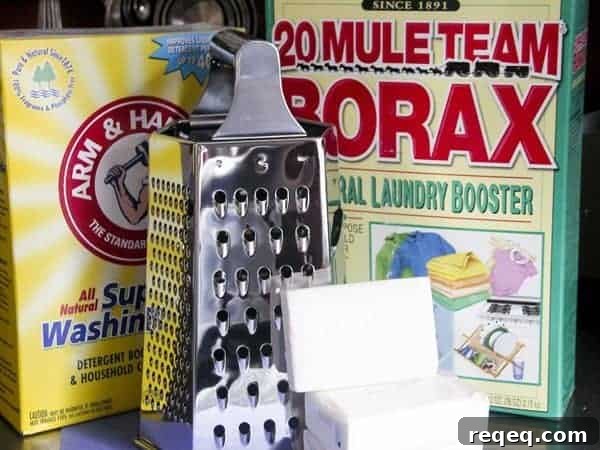
Homemade Laundry Soap
Ingredients:
- One five-gallon plastic bucket with a tight-fitting lid.
- One bar of gentle soap (Ivory, Dr. Bronner’s or other non-lotion bar).
- 1 cup washing soda.
- 1/2 cup borax.
- 4 cups warm water plus 4 gallons warm water, separated.
- Optional: 10–40 drops essential oil of your choice.
Instructions:
Grate the bar of soap on a metal cheese grater. Do not use a plastic grater; plastic can absorb soap odors.
Place the grated soap in a stainless steel or glass saucepan with 4 cups warm water and heat gently, stirring until the soap dissolves. Avoid pans that can absorb odors.
In the five-gallon bucket, pour 4 gallons of warm water and dissolve the borax and washing soda. Stir well, then add the melted soap. Plunge the saucepan in the bucket a few times to rinse any remaining soap into the mixture.
If using essential oil, stir it in now. Cover the bucket tightly and let it sit overnight.
The next morning the mixture will have a thick, gel-like consistency. Stir thoroughly, breaking up as many lumps as possible. Some lumps may remain, but that won’t affect performance.
Store the detergent with a tight lid for up to two months. If you need a smaller batch, use 1/4 of a bar of soap grated into 1 cup warm water, 1/4 cup washing soda, 1/8 cup borax and 1 gallon warm water. Add 3–10 drops of essential oil for scent if desired.
To use:
Use one cup (8 fluid ounces) of the laundry soap per load. Because this detergent produces little to no suds, it is suitable for high-efficiency washers as well as standard top-load machines.